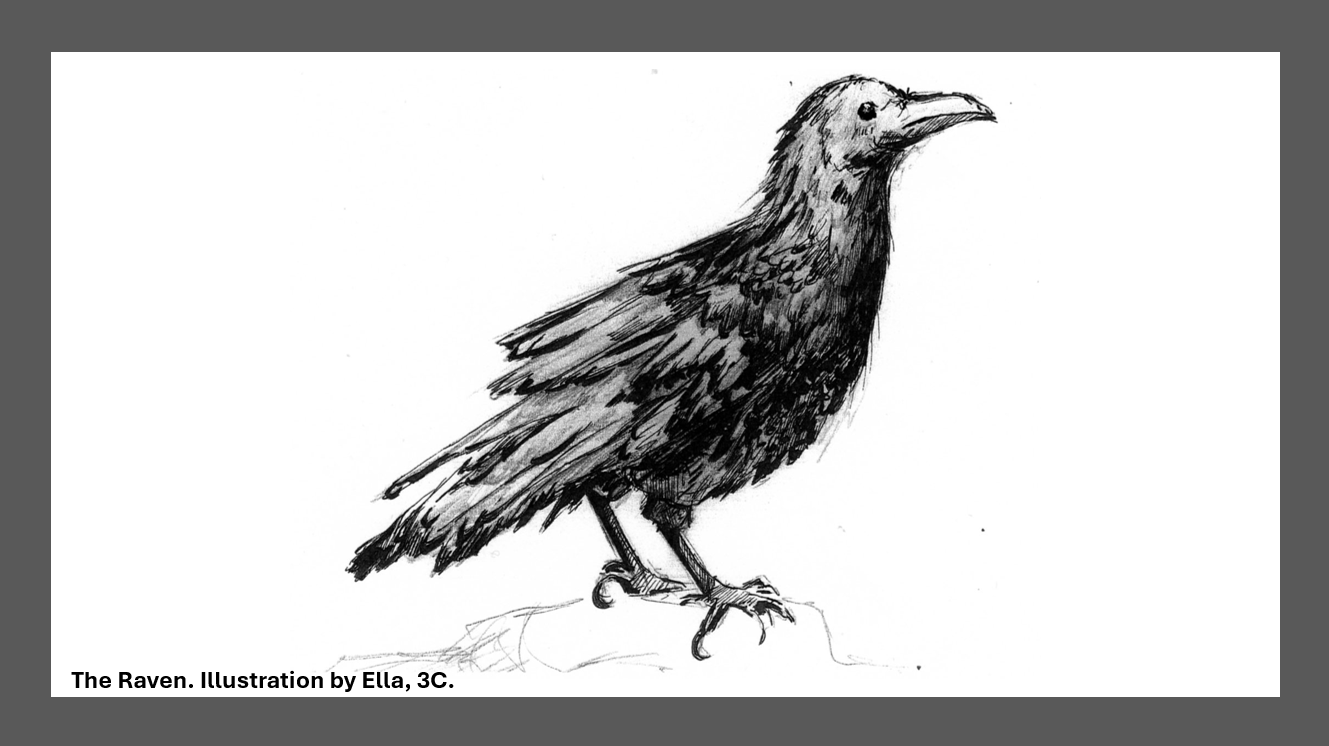
This year’s 3me have a very good level of English, so just before the Christmas holidays I decided to challenge them by reading Edgar Allan Poe’s long and rather complex poem The Raven (1845) and give them a taste of Gothic literature. The work on the poem went well, and some students appeared to like it so much that I was inspired to challenge them further and let them write a literary response to Poe’s poem from the Raven’s perspective: Who is this ‘ominous bird of yore’, what is its connection to the beloved Lenore, and why is it visiting the speaker on that dark December night? And what does it mean with its repeated ‘Nevermore’?
Through this exercise, the students learnt quite a few things: some characteristics of Gothic literature (genre awareness), how to work on their writing to make it ‘literary’ (style), what intertextuality is (literary theory) and, not least, that no matter how good you are at imagining and writing, you still need to work a lot on your text before is ready to be published.
Below are some of the best texts and illustrations by some of the more hard-working and ambitious students for you to enjoy – without fear now that the dark and dreary months are well behind us.
En français: Cette année, les élèves de 3e ont un très bon niveau d’anglais, donc juste avant les vacances de Noël, j’ai décidé de les mettre au défi en leur faisant lire le long et plutôt complexe poème d’Edgar Allan Poe, The Raven (1845), et de leur donner un aperçu de la littérature gothique. Le travail sur le poème s’est bien déroulé, et certains élèves ont semblé tellement l’apprécier que cela m’a inspiré de les pousser encore plus loin en leur proposant d’écrire une réponse littéraire au poème de Poe du point de vue du corbeau : qui est cet « oiseau sinistre d’antan » ? Quel est son lien avec la bien-aimée Lenore, et pourquoi rend-il visite au narrateur en cette sombre nuit de décembre ? Et que signifie son « Nevermore » répété ?
À travers cet exercice, les élèves ont appris plusieurs choses : certaines caractéristiques de la littérature gothique (conscience du genre), comment travailler leur écriture pour la rendre « littéraire » (le style), ce qu’est l’intertextualité (théorie littéraire) et, surtout, que peu importe à quel point on est doué pour imaginer et écrire, il faut toujours beaucoup retravailler son texte avant qu’il soit prêt à être publié.
Vous trouverez ci-dessous quelques-uns des meilleurs textes et illustrations réalisés par certains des élèves les plus travailleurs et ambitieux, à savourer sans crainte maintenant que les mois sombres et lugubres sont derrière nous.
Pluto’s Message
Once upon a dreary midnight, I was sent as a messenger by Pluto, my master, to deliver a message to a certain person. As I left the underworld, my body started shrinking, and by the time I was out, I took the form of a raven which embodies the sign of death that I was ordered to bring.
Upon my arrival at his house, I came in through an open window and started pecking at a door. While I waited, I heard a voice, but was unable to discern what it said. A few more minutes passed and nothing, the door was kept shut, so I left through the same window I came in from, circled around the house and pecked on one of the other windows. This time the window was thrown open, I flew in and perched myself upon a bust of Pallas just above the chamber door.
As I looked down, I saw an old man, he looked nearly eighty years old. He asked me what my name was in the underworld, I tried to answer but all that came out was “Nevermore”. I was confused at first, but then I understood that the form I had assumed was unable to say anything besides a riddle-like version of the message I had been commanded to deliver. My only way of conveying the message that his death was approaching was “Nevermore” and that Nevermore would he be able to do or need to know anything since he would soon be dead. He then muttered, “other friends have flown before on the morrow he will leave me, as my Hopes have flown before” to which I could only respond: “Nevermore”. He started at this and seemed to understand that this word was all I could say. The old man then fell into madness and called me a wretch, assuming I was sent by the angels. I answered “Nevermore”. He then understood I was a messenger of sorts and called me “Prophet”.
At that moment, my body returned to the underworld and an illusion was left in my place over the old man’s chamber door, still in the form of a raven, to remind him that the time of his passing was approaching. After I fulfilled my assignment, this man’s insanity would grow significantly during his last days on the mortal plane, to the point where his soul was bound to the house he lived in, haunting it and forever exhibiting aggressive behavior towards anything that resembles a bird.
Léopold, 3A
Messenger of Death
I am the messenger of Death. I am the Raven and I hold the souls of all the dead. That is why, when I received Lenore’s soul, I was obligated to deliver the message to the man who was still caught up in futile dreams.
There he sat reading forgotten lore, dreaming of what could have been. When he opened the window and let me in, I perched above his chamber door. He started talking about the death of Lenore and how much he missed her. I wanted to console him, but Pluto had ordered me to say only one word, “nevermore”.
Not long after, the man started begging for Lenore, but she wasn’t Lenore anymore for that name was meaningless now. She was just an empty soul inside of me and all I could tell him was “nevermore”. He would never see her again. He would never hear her voice again and her smile was forever lost in the darkness of the underworld. Yet he kept imploring. Then I began to realise what it was he was feeling. That supernatural power that makes you mad and distracted. I think it is called love. He loved Lenore to such an extent that her death was impossible for him to accept.
So, before leaving I wanted to give him what for him was the most important in the world. I gave him Lenore’s soul, gentle and sweet and bound to fill his heart like warmth filling a cold room. Then, I flew off into the dark night so that he would see me — nevermore.
Théodore, 3A
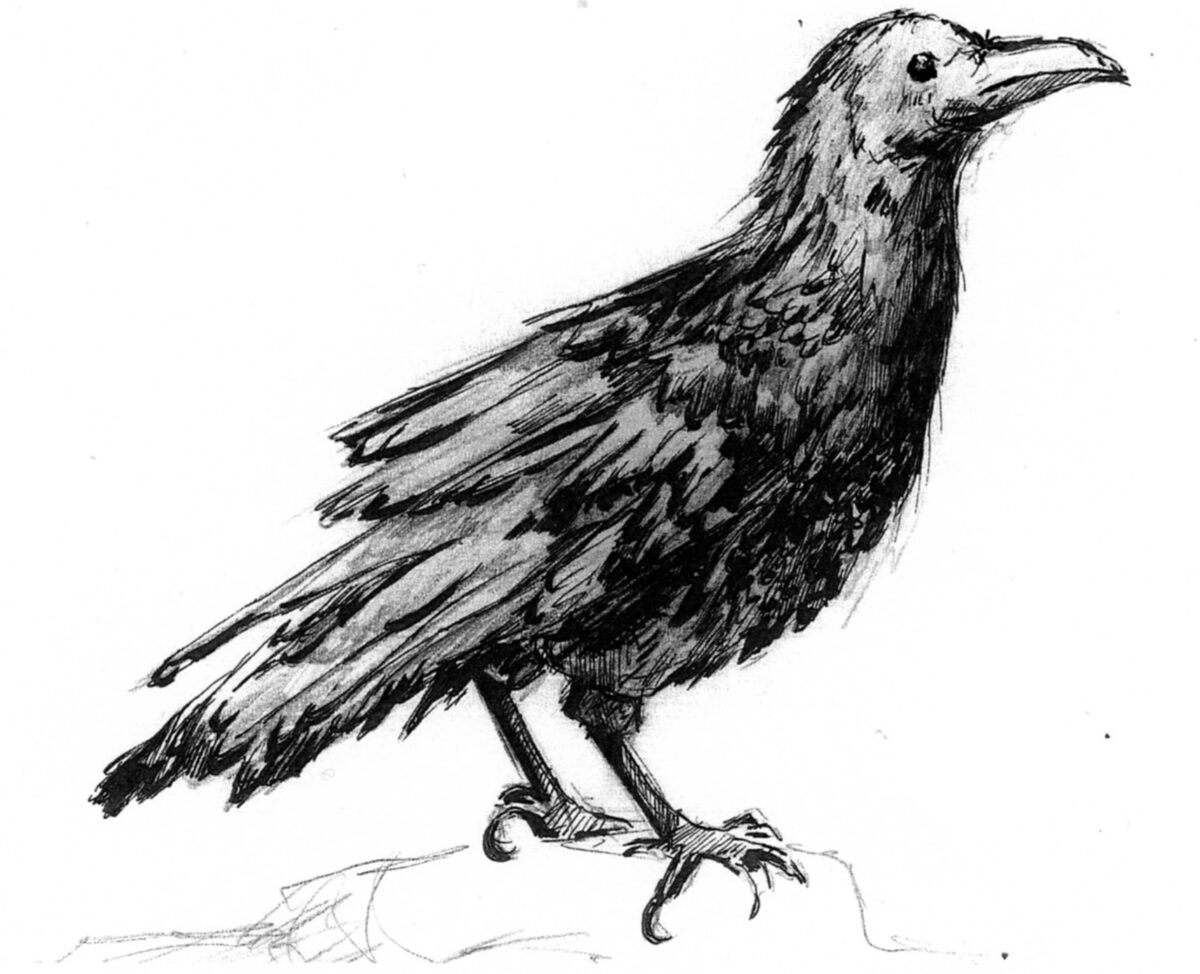
Lenore’s Revenge
The dark forest beneath casts a long shadow over the lake. The wind is cold and loud through the black feathers I have just acquired. I am flying to his house.
A long time ago, he ruined my life. The life I have no more. That day was about to be the best day. I was marrying my fiancé. All was impeccable; my life was finally falling into place. But as the musicians started to play, I heard a strange scream. A man’s voice repeating “Nevermore. Nevermore.” I hurried towards it in my long white dress, unprepared for what I was about to see: my soon-to-be brother-in-law had violently taken the life of my fiancé. He turned towards me whilst he kept yelling “Nevermore! Never-more!” brutally stabbing repeatedly at my bosom. At that moment, a cool shiver of sadness and darkness spread through me. As my life began to fade, I prayed that I would one day come back and get my revenge. I wanted to make him suffer.
Now the time has come. I arrive at his abode. I begin tapping and rapping on his chamber door, then his window. His voice echoes through the cracks. He opens wide the window and I perch myself above the chamber door. The questions flow out from his blushing lips as I only answer with “Nevermore, nevermore!”. The question hangs above us. Finally, he murmurs the delicate word “Lenore”. That same shiver of doom and despair runs through me. But it soon turns into burning hatred. I lunge at his repulsive face; I stare into his horrendous eyes before I claw them out. He moans loudly, giving me a sense of satisfaction that does not reach its climax until I rip open his throat and quench my thirst.
He lies on the cold floor, blood pooling around his body, frozen and gasping for his last breath as I soar, jubilantly, to join my fiancé.
Charlotte, 3B & Aurore, 3A
Judge of Death
I am the Judge of Death. I come as a raven; I watch people from the shadows and from places they cannot reach. I do not judge people for my own amusement. I judge people because someone must remember what they did to others. I must remember what people did. A kind soul, I think her name was Leonore, sent me to do this job because she was really scared and really hurt. When she was alive, nobody listened to her, so now I am her voice.
One night I flew into a dark room where a man was trying to forget what he had done. He heard my wings before he even saw me. I observed him for a long time. He looked shocked. When, at last, he asked me why I was there, I just answered him ‘Nevermore’. I looked at the man. I could feel how scared and sorry he was. But he still hurt Leonore. He was still guilty and his sentence was death. I feel no regret.
Dimitri, 3B
The Ancient
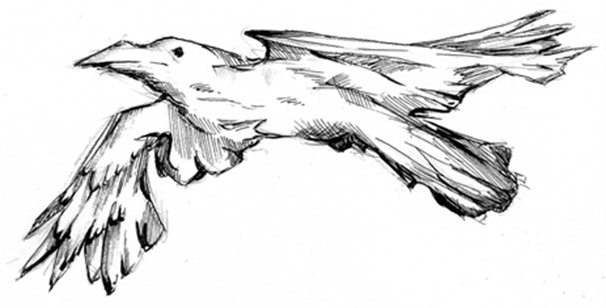
The Raven soared through the grey clouds, the wind whipping at its wings. It was a sizeable bird, significantly larger than others of its kin, though its feathering was tufted and greasy, thinning in places. Its eyes were devoid of any sheen, reminiscent of a bottomless well. This was no ordinary raven, this was a creature old as time itself, a creature from long before any human had ever set foot on earth.
The raven was well acquainted with mankind, after all, they had given it its purpose. The bird made a sharp dive down towards a grey, gloomy looking chateau. It did not sway in its path, holding unshakable trust in its own ability.
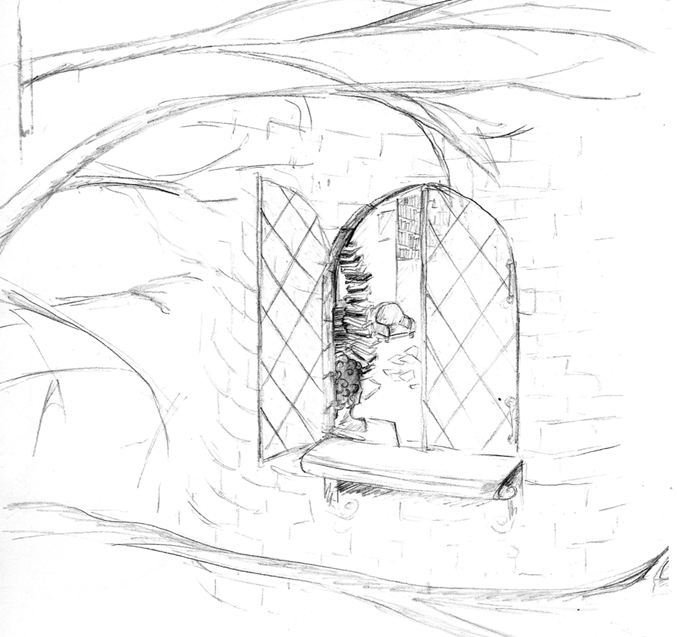
It landed on a windowsill, peering in at the man who sat beyond the pane. He was frail-looking, with a bony face and paper-thin skin stretched over his skeleton like a sheet. He was bent over some heavy volume splayed open on his desk.
The bird tapped its beak on the frosted pane; eyes fixed on the man’s shadow. It flickered in the candlelight, looking as though it was moving independently of its master, fighting to escape the darkness of its confines. The Raven tilted its head, giving another, more insistent rap on the glass. The man finally stood up, muttering under his breath as he threw the window open. He stumbled back, crying out as the bird flew through the room and perched on a marble bust. The room was rather sombre, its only sources of light being a lantern by the door and the tallow candle flickering on the man’s desk. The smell of tallow, parchment and leatherbound books permeated the chamber. The walls were covered with bookshelves filled with thick volumes. A large Persian carpet covered the floor, where the man now stood, wide eyed, gaping at the feathered foe. He called out, in a whiny voice, asking for its name. Always such futile questions. would they ever learn? What importance could a name hold in the long run? None! There had been a time in which the Raven would indulge in human curiosities, but that time had long since passed, so, it spoke the only word it still used. “Nevermore”
The man flinched, asking another question. And another. The Raven never gave any answer other than that singular word. Finally, the man exclaimed something, throwing his arms out to the sides. It was a frustrated move. The Raven tilted its head, blinking at his tantrum. Rather pathetic, really. Humans always seemed to let their emotions take them over. Slowly, the bird spread its wings, having had enough, and descended upon him.
A blood curdling scream echoed through the stone halls; it was the kind of raw sound someone only made in moments of absolute horror. Claws sunk into flesh. Blood stained the carpet. The raven sat atop the body, peering down at the pale face. Unblinking eyes stared back up at it. It hopped off onto the floor, pecking at the shadow, partly hidden under the man. Shadows, or rather, the souls they contained, were what the bird lived off, after all. It reached under his neck with its large beak, tearing a wound open just under the nape, tugging at something. Blood poured out, staining the thick carpet, but the raven kept pecking at the shadow.
The Shadow suddenly came to life, fighting against the bird with fervour, but it was no use, it was soon devoured. The world seemed to still for a moment. An eery quiet, broken only by the gulping sounds coming from the bird.
Soon, a raven emerged from the large window, but it was not the same as the one that had entered it. This one was significantly larger, sated. The wings were perfectly feathered, reflecting the moonlight with a surreal shine. It soon spread its wings, taking flight. Back in the chamber lay a cooling corpse.
Kim, 3C
Read the whole poem : The Raven (1845) by Edgar Allan Poe